A journey of a thousand miles must begin with a single step
– Lao Tzu
This is the first post on my new blog. Never thought I would blog and let out the many little thoughts in my head…but then why not? Life and learning is always a journey and if we can’t embrace new things and LIVE, we are stuck.
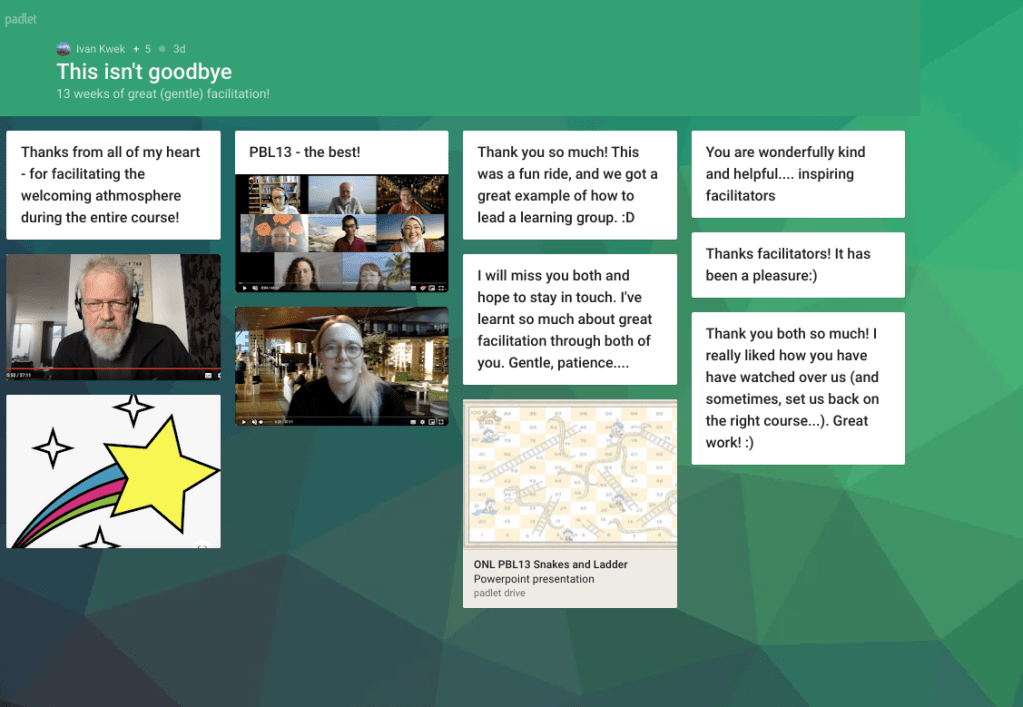
We had our final meeting and thought to write out our appreciation to our group facilitators on Padlet. For a few of us in the group, Padlet was an entirely new tool which we learnt about during ONL201. We experimented with it and got used to using it over the course of the 12 weeks, and by the end, we were very familiar with a range of online tools. These included Padlet, Mind-meister, Mentimeter, Flipgrid, and of course ZOOM.
This was the beauty of ONL. While there were members of ONL who were clearly more digitally literate then others, there were many of us who were not. We were not as familiar with available tools for online communication and teaching. I certainly learnt through ONL that one can have familiarity with some tools, like FaceBook for example, yet also be unfamiliar with how we might navigate online. Indeed the very first few weeks of ONL was an eye-opener in making me realise that we needed to think through the concept of being digitally literate, and not assume everyone was necessarily on the same page.
I have gained tremendously from my participation in ONL. I was of two minds on whether I would have the time and energy to participate fully in ONL, and in fact when the call was sent out by my institution to consider joining this 2020 run of ONL, I wrote back to say that I was interested but had serious concerns about whether I could space the time. I have been heavily involved in university administration over the past two years and it was daunting to imagine having to put aside time for reading and engagement online. I didn’t think I could do it. Thankfully, the institution’s lead for ONL wrote back to encourage me to give it a try. I am so very glad that I did.
There are many things I learnt from ONL. These were concrete take-aways, such as learning about online tools, digital literacy, success and failures of group collaboration and of course my first real exposure to the community of inquiry (COI) concept and practice. I was blown away by the idea of emotional presence and am really now curious about how I can be fully cognizant of these concepts so as to improve my own teaching, whether physically face-to-face or online.
However, beyond just the concrete learning, one of the best things about ONL is the fact that it is a truly immersive experience in learning. The aim of ONL was to teach us about collaborative online learning – what it’s about, what are its potentials, what it takes to make this successful (or unsuccessful), and the beauty of learning design. The entire module was designed to help us – the learner – truly experience the concepts even as we debated or read up on it. It was in many ways about learning by doing. I literally saw and experienced online collaborative learning as I proceeded through the course. And to me this proved to be such an effective way to learn.
Each week we were exposed to the literature, with the appropriate broad “lecture” by the topic’s lead instructors, after which in our smaller groups we could debate and work on a project. These projects emerged out of scenario and we had the FISH template to guide us. We were never fully aware of the FISH template but it served as an important framework to move the smaller group discussions as we worked, or tried to, collaboratively. In the process we experienced collaboration and the fashioning of a community of inquiry as we progressed deeper into the concepts and ideas. I found this learning by doing highly effective.
At the end, I saw online learning through the eyes of a learner. I saw what it must feel like for a student if there were clear instructions, and if there was none. I could see the tremendous value of good facilitation skills, a guide for the group but not overbearing such that the views of the different members were ignored or subsumed. I learnt how important it was to set aside time to work on ground rules and come to an agreement/ understanding of how the group work/ collaboration would progress, the role of group leads, and how to build commitment from everyone into the collaboration.
For the learner, the importance of clear and organized learning design would make or break the learning experience. There are different components parts – including working through assessments – that would need careful thought. We cannot assume commitment and motivation for online collaborative learning. It had to engineered and it can be engineered in a way as to make learning online truly enjoyable. ONL convinced me that in a world where we have little choice but to teach and learn online, it can be done. We just need careful design.
I will admit that ONL has left a big impact on how I think about my own teaching. It has ignited in me a passion to know more about pedagogical approaches around the COI. It has enabled me to fully experience the importance of student-centered learning design. If anything is to improve, I would want to go deeper into an ONL Part 2. I feel that I have only scratched the surface and would like to learn more.
I have to admit that I have never thought *overtly* about PRESENCE in the classroom. Like many, I have been trained to work on instructional design, which means I am mostly consumed by designing my modules to ensure that students are able to “learn” the content by the end of the semester. Each weekly topic is normally a sub-section of the subject matter that taken together the student must have “learnt” by the end of the semester.
So to hear, read and reflect on PRESENCE as articulated by the Community of Inquiry framework is eye-opening. It resonates with various issues that I have grappled with in my own teaching, concerns about how to better engage students, and how to get to a deeper level of learning on subjects which are often perceived as sensitive or “difficult.”
Transiting to Blended Learning
A couple of years ago, I put together a typical seminar-style module on the subject around religion and politics. The institution felt that there was a need to engage the students on a sensitive and controversial subject in the aftermath of 9/11 and global terrorism. There was some nervousness around the course, both from the students who were worried about speaking on the subject with little knowledge of the religion, and among the School’s administrators who were worried about a possible fall-out if the class become “too emotional” and would create divisions among an already very diverse student body (students of different nationalities and also religious inclinations).
Understandably the class started small. The first iteration of face-to-face, in-class seminars centred around weekly topics, students presentations and subsequent discussion around the presentations worked well. Our problem proved to be poor time management and sense of “feeling lost” as we never wrapped up each topic properly, even if there was clearly no right or wrong in the discussions. Students enjoyed the class but there was still something lacking. In the student feedback students commented on not having time to fully reflect on the subject matter.
After a few tries at better time management, I inadvertently stumbled into designing my first blended learning module. The experiment, albeit imperfect, produced one of the most satisfying modules I have ever taught. I say stumbled because it evolved out of the suggestions from a few students. After Week 2 of the module that semester, two students approached me and said that they thought it might be good if there was a way for questions and “confusion” among the students to be addressed outside of the face-to-face class time. One of them volunteered to start a discussion forum where questions and additional materials could be generated from among the students, with the more “knowledgeable” ones facilitating. I remained wary of handing part of the class to students – after all I was the instructor – but relented and gave it a try.
This paved the way for discussions to occur asynchronously on the University’s learning management system (LMS). I readjusted the design of the course to include scaffolds that would be emailed to students and uploaded a week earlier, from which the students could then start engaging on the discussion forum among themselves, facilitated by the self-selected student leads. This helped significantly in alleviating the stress of too much material to cover in a single face-to-face interaction, and I began to see students start engaging with each other and with the subject matter in a deeper way. The students adjusted to the new design quickly and liked it. They were far more comfortable to discuss the issues/questions at their own pace and in their own time. The discussion forum allowed this to happen.
Creating Space for Emotional Presence
More interestingly, several students, in their discussion forums, spoke up early on about their worries about discussing a sensitive subject like religion, and felt uncertain about how their own emotions may interfere in their “objective learning ” This was a very interesting set of observations among the students, and led me to think about how I should help get the students comfortable with their own emotions so that we could in fact learn about the complexities around the subject. I realised then – almost like an “AHA!” moment – that I needed to factor emotions in this module. The question was how?
As it turned out, again, the students came to the rescue. I had two students in the class who were clearly at the opposite ends of the ideological spectrum, though they were Muslims. We agreed that we could spend the next 2-3 face-to-face classes to engineer a debate/discussion around scenarios in class. My role as facilitator was to help students navigate this safe space with their emotions present, and to acknowledge and celebrate all expressions of emotion in the debate. We allowed ourselves to ask questions that may seem offensive, laugh at each other’s comments, come out as a passionate advocate or detractor, sometimes deliberately in a role we wanted to play. We had FUN.
This was not in the original plan for the course and I remained worried about the materials that students needed to cover by the end of the module. But with us beginning to use asynchronous discussions, scaffolds, and scenarios, we were able to get the face-to-face classes to be about deep, open, engagement. The overall social and emotional presence we were collectively able to produce in this course was truly amazing. By the end of the module, students were fully engaged with me, with each other and with the content. It was evident from their assignments how much more they learnt by engaging with each other. To this day, they continue to engage with me and with each other on the subject matter via WhatsApp even though many returned to their home countries.
I became a convert to the blended learning, and without necessarily knowing it at the time, to the importance of PRESENCE and a Community of Inquiry framework to deep learning.
How Now? Emotional Presence in Online Blended Learning
The Future is Here – FULLY ONLINE
I was recently approached to convert this module into one that would go fully online. There is interest, the University explained, for a module like this to illicit an important discussion among a larger global audience. I have been struggling for a while now on how we might convert a blended learning module, where face-to-face, physical presence has been central to helping engineer full presence in the learning, to one which would be 100% online, without any physical, in-class contact.
How can I replicate these debates and discussions in an online space?
The debates that we had in the class required physical presence. Students were able to react and respond to the body language, gestures and intonation in the statements that peers were making. How can we do this in an online space where we would need to depend on asynchronous discussion forums and possibly shorter more static synchronous, “LIVE” ZOOM sessions? We also already realize that ZOOM sessions end up being exhausting because they tend to be staged and the recording element creates an atmosphere of play-acting.
So How Now?
———————————end of part 1 ————————————–
References:
Cleveland-Innes, M., & Campbell, P. (2012). Emotional presence, learning, and the online learning environment. The International Review of Research in Open and Distributed Learning, 13(4), 269-292. https://doi.org/10.19173/irrodl.v13i4.1234
Garrison, D. R (207), “Online Community of Inquiry Review: Social, Cognitive, and Teaching Presence Issues” in Journal of Asynchronous Learning Networks, v11 n1 April, p 61-72
Some years back my institution embarked on what seemed like a radical experiment (it wasn’t that radical actually but it appeared so at the time)😊. They wanted to create a truly multi-disciplinary module that would have three teachers, team-up, to provide a multi-disciplinary take on a wicked real- world problem. This sounded like an excellent attempt at collaborative teaching, that would, it seemed, be highly beneficial to students as they would get a “truly” multi-disciplinary” perspective. I volunteered to join the team.
The experiment failed miserably and left me rather “tainted” by the idea of multi-disciplinary approaches and collaboration in teaching. I initially blamed it on what I felt was the difficulties around trying to teach across disciplines. I stayed away from the idea of teach teaching and preferred, as I said to my Dean, “simply to have my own class.”
But then, a couple of years ago, I was approached to consider collaborating with several others on an online module. The collaboration would involve four other professors and their classes in four different universities. I was still afraid but I was intrigued at the possibility of working with individuals in far flung places – how could we collaborate to run a class with students from different places, cultures and institutions? We had to begin with it being partially or fully online. So again I volunteered.
My experiment with the online collaborative module was sharply different from my attempt at collaborating in a face-to-face module. Th difference did not centre around the fact that one was online and the other not. It centred on the fact in the online course, the four of us truly collaborated in trying to build a learning community. We started with trying to work through our course design so that we could connect all students in the separate courses together. We collaborated in the production of instructional materials so we opted to put a syllabus together based on our individual/existing syllabi, and reworked it to accommodate the topics that we were “experts” in. We shared resources including the videos, reading materials, slides and scaffolds. We explored various online tools that would enable us and students to meet online though they were far apart. We explored various assessment modes that would encourage peer-to-peer learning among the students.
We were not successful the first time around. But we shared openly the problems and sought a solution. For example, we noticed that the timing of the group work among the students were too compressed and this made it very stressful and made it difficult for students to collaborate. We realised quickly the importance for there to be an ice breaker for students to get to know each other and to set the “rules of engagement” so that they could proceed on with their group work. The design of the group project for students also necessitated a focus on producing something that could build on the different/diverse strengths of the students, and we needed to find a way for students to realise this and contribute to the collaboration. We had to produce something that the students could collaborate on asynchronously as part of their group assignments.
Many of these factors – openness, sharing, trust – among the team of teachers had been missing in my first experiment. Then we compartmentalized the knowledge, and assumed that it was contained within the discipline, and within the “domain space” of the teacher. There was not real effort to see the process of co-creation. Neither did we sit and share to design the module from scratch.
In both experiments we had diversity of perspectives/training/disciplines in the team. But in the latter experiment we co-created a module, building on each team member’s existing body of knowledge and curating the materials into a whole. Diversity in itself did not produce anything novel for the student, and in the case of the first experiment proved to be an abject failure. In the second experiment, we chose to take that diversity and harnessed it to build a learning community.
In the end, it was not full-proof, and there were many problems that remained along the way, but it led me to see what collaborative teaching and learning can be about if done properly….
I was asked to read up and reflect on open access education. In the course of reflecting on it, I realized that “open access education” is in fact quite a strange thing for me to internalize as an educator within an institutional setting. I realized quite quickly that many of us are not as open to sharing our knowledge and giving others access to it other then what we would share within a controlled classroom to enrolled students. Openly sharing our course materials – resources which we may have painstakingly created on our own – isn’t a natural inclination. Even if we collaborated with a colleague on a course/module, the instinctive approach would be to separate out the parts so that we would “own” them.
The institution reminds us of this from the day we sign the contract. Throughout our time with the institution, we are reminded about intellectual property rights, and about who owns those rights if you are a member of the institution. For example, I learnt quite quickly that a course I created would be the property of the University which employed me. On top of that we are often dragged into extensive discussions on what we may (or may not) want to charge individuals who may want access to course materials but are not registered with the University.
Learning management systems (LMS), like our classrooms, are also designed to be closed. They are not opened to students or faculty from outside the institution to use.
Access to higher education is, in reality, closed. A major reason for this is because we have made education, and in particular higher education, a commodity. We seek to charge a price for knowledge, and in so doing we need to keep the systems closed. To an extent this only makes sense as we should be able to generate payment for those developing and producing the knowledge.
However, cutting access to higher education ensures that we can charge a higher price, more so when we create a brand and market exclusivity for certain brands of education, or we restrict access in its entirety. In this dynamic, education, and more so higher education, is not a public good, with equal access to all. Inequality in our access to, and the overall quality of education, has became a reality in the the modern world.
When online education first appeared on scene, it raised the possibility that education would finally become accessible to all. Instead of classroom access being controlled and subject to premium payments, individuals could gain access to resources, materials and knowledge through open, networked platforms. Tech companies promised a way to by-pass institutions and allow individuals to access an education from wherever they sat, literally. This was touted as the true revolution, where access to an education would be opened to all and promised the possibility of greater equality across communities.
What we know now is that this promise has been rather hollow. The technological revolution almost automatically meant that there would be a divide between those who had access to the technology and those who did not. There was also quickly a growing divide between those who ere familiar and comfortable with technology, and those who found technology overwhelming.
To add to this, as tech companies jumped into the education space, they too sought to commodify education through Massive Open Online Courses (MOOCs). The controlled classroom was opened to hundreds around the world but at a premium price. Tech companies like Coursera joined hands with universities to roll out courses that allowed for “students” all over the world to engage with a professor on various topics but with the aim of increasing revenue and making a profit. Some have argued that this in this post-modern age, education has been even more highly commodified.
In reflecting, it is quite clear to me that the proliferation and expansion of MOOCs has not harnessed the ideas of collaboration, and empowerment, that is so central to the idea of open access education. Open access does not mean we do away with intellectual property rights or that we do now ask for a recognition of the knowledge we produce. Recognition of this in the form of some payment is fair. But we can allow for many others to access what we produce open and to add to it. We can openly collaborate to produce knowledge together and this includes collaboration with those we seek to “teach.”
There are now many articles out there highly critical of tech companies and what they do for our access to education. Many are critical of these companies for charging exorbitant prices and for failing to allow for real “open access.” The question remains on what alternatives remain for “open access.”
Reference:
Douglas J. Cremer, Education as a Commodity: The Ideology of Online Education and Distance Learning
I have been trying to find the time to sit and write this page over the past weeks. The first step as they say is the hardest. And when it comes to typing my thoughts down, it seems I am struggling with more then time….
Yet, I find myself in a new reality these days.
Each morning I wake up to news about COVID-19, each day announcements on further restrictions to movement, and further calls to tighten safety measures especially to limit students in a classroom for fear of spreading the virus. We are really in challenging times as we have had to grapple with operating in/on an online space almost overnight and in a way in which we have had no choice but to do so. This has added significant pressure and stress to both faculty and students. Faculty seemed unprepared and fearful when asked to switch to teaching in an online space. Quite a few resisted in the first few weeks when the University made the decision to minimize possible community spread of the virus from within the classrooms. The reasons for resistance ranged from strong disagreement of the quality of online teaching (as opposed to face-to-face interaction especially for post-graduate education) to concerns over confidentiality over content/information that was being shared in the classroom. The fear can be linked to a lack of familiarity with online tools for teaching as well as a situation/realization that the course had not been specifically designed for online teaching or interaction. There were real concerns about how to ensure engagement in an online space. Understandably, faculty were concerned about how they can maintain/sustain the quality of their class when they had to shift to an online format instantaneously. In the face of clear instruction from the University that faculty had to shift their classes to online teaching, there was little choice and faculty requested substantial support to shift. This meant actual physical help with webcasting and set-up/working with ZOOM. Faculty who struggled the most were those who did not have exposure or familiarity with a range of online tools e.g. Twitter, FaceBook etc.
Interestingly, age has not been a factor in the distinction between those who were open and comfortable with online tools and those who were not. It was about familiarity with online tools, familiarity with different pedagogical approaches, and time. By this I mean that the time pressure e.g. “you’ll have to switch to e-learning” was perhaps the hardest to adapt to… And this was not restricted to faculty/teachers. This was the same set of issues that students grappled with. Students were equally unhappy and uncomfortable with the e-learning but accepted it as an emergency response to COVID-19. They may have been much more familiar with online tools and in many instances agreed to assist the professors with the switch but the younger cohort – those familiar with a highly interactive process in the learning space were the most unhappy at having to switch e-learning.
So what do we need to do to create a “comfortable” space for teachers and students in online education or with regards to online tools?
Knowledge and familiarity – exposure to online tools, what they can do and what their shortcomings are
Time – to shift and make the adjustments; the more both sides are under pressure to use these tools and to show that they can use it, the harder and more painful the experience
Design & Experimentation – it takes a lot of design and experimentation to get online use and online teaching to work
So how? COVID-19 has forced us all to confront our fears. It’s emphasized the great divide around digital literacy and how the unregulated online tools do not quite help address the illiterate. Simply telling people that they need to be digitally literate doesn’t make it happen.
I’ve long been passionate about education. I come from a family of teachers and from the earliest time, I’ve wanted to be a teacher. My mom and aunt – who were teachers – used to bring me to their schools so I could watch them teach. My life changed course because of amazing teachers when I was a teenager…individuals who took the time to make me believe that we could be as amazing as we wanted to be, no mater what!
Over the years,however, as I pursued my passion in academia, I’ve been confronted with seismic shifts in the higher education landscape. Not only have I seen the value of good teaching get undermined in the name of research impact, I have also seen technological advancements fundamentally question the value of teachers in the classroom.
Higher education is no longer what it used to be. We now have MOOCs, blended learning and other hybrid models that question the typical face-to-face top-down mode of teaching. The role of the professor as the “expert” imparting his/her knowledge to a rapt audience of students is no longer tenable. So what is the role of a university professor? Why do we even need a university professor in the age of Google? Compounding this is our new reality where physical spaces in universities have been forced to shut down, and students/professors learn and teach from home.
We are already in a new age. There is no turning back. As I walk through through this evolving/ shifting landscape, these reflections serve as a note on my journey. I am not sure where it will take me. It is not, as they say, the destination that matters, but the journey. At the end, I hope that they can serve as a publication of my thoughts, from the personal to the public, on my my role as an educator.

 SK'S REFLECTIONS